
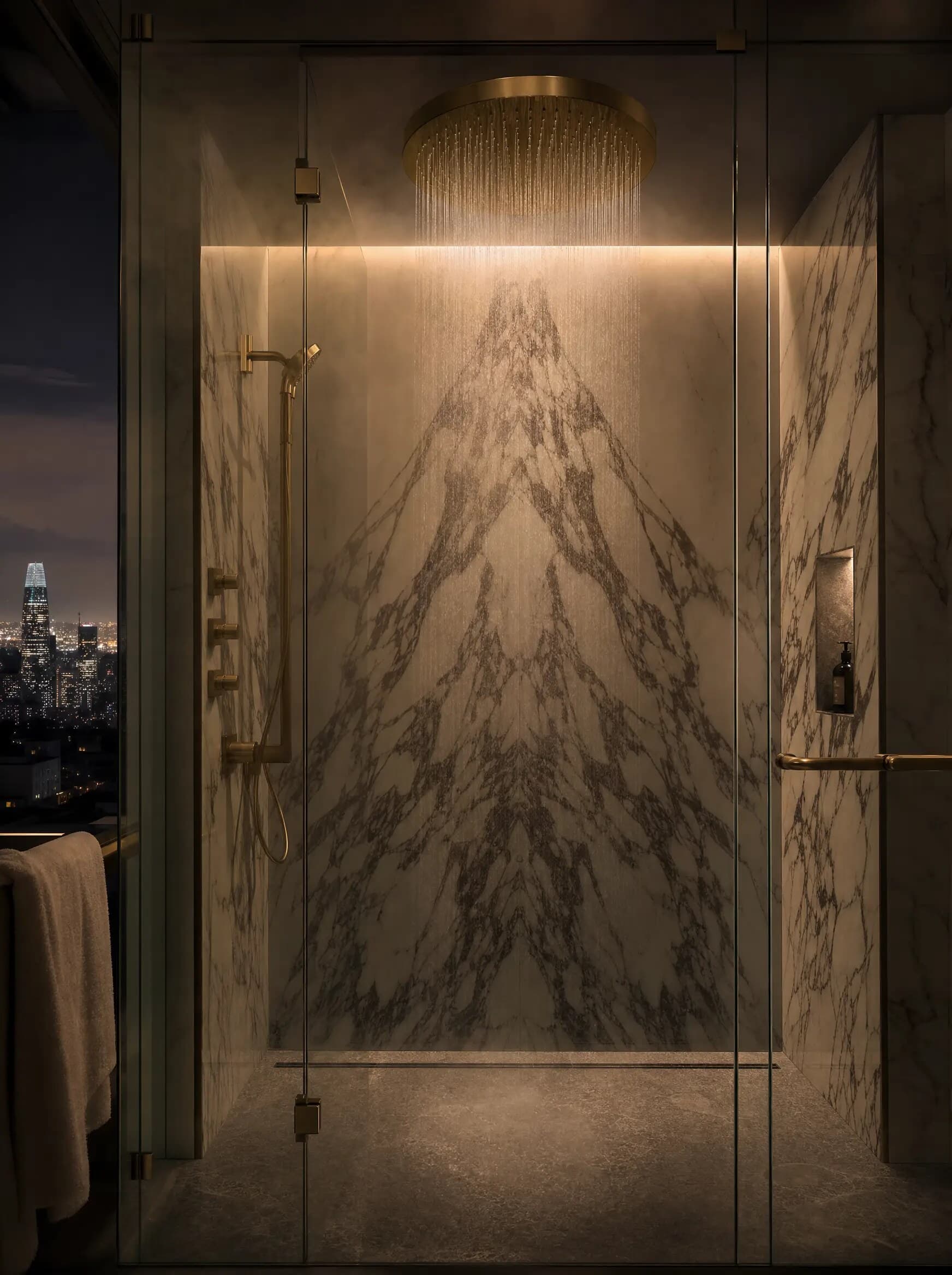
Search any of these brand names with the word plumber and you get showrooms. Showrooms sell the fixture. They do not come out when the thermostatic valve behind your tile stops holding temperature seven years later.
Under those search results sit forum threads with the same three questions, mostly unanswered. Who will touch this. Where does the part come from. Does the wall have to come apart.
We install and service these fixtures as ordinary work, so here are the answers, along with the decisions that determine whether a five figure fixture package is a pleasure to own or a recurring problem.
Why most plumbers decline the work
It is a rational decision on their part, and understanding why explains most of what follows.
The parts are not on the truck. A trade supplier stocks cartridges for the four or five brands that make up most of the market. A German thermostatic cartridge or an Italian ceramic disc is not in that inventory, and often not in the country. A plumber who takes the call is committing to a diagnosis visit, a sourcing exercise, and a second visit, on a schedule they do not control.
The tolerances are unfamiliar. Rough-in valve bodies from these makers set the depth of the finished wall. Get it wrong by a small margin and the trim will not seat, and the correction is behind tile. A plumber who has not done it does not know what he does not know.
The finishes are unforgiving. A wrench mark on a chrome mixer is a repair. A wrench mark on unlacquered brass or a living finish is a replacement, and the replacement is a lead time.
The liability is asymmetric. On a fixture package worth from two thousand to fifty thousand dollars, the value of the part exceeds the value of the labor by a wide margin. The upside on the job is one afternoon's rate and the downside is the fixture.
So the work concentrates with the few firms that do it often enough to know it and to stock the parts. That is the market you are searching in.
Installation is where fixture problems are born
Most fixture failures we are called to are installation failures reaching maturity.
Valve depth. Every concealed valve has a finished wall range printed on it. The rough-in has to be set for the actual build-up of substrate, waterproofing, thinset and stone, decided before the wall closes, from the tile shop drawing rather than from an assumption. The most common defect in a high end bathroom is a valve set from a nominal number and finished a quarter inch out.
Backing. Wall mounted spouts, wall mounted basin mixers, floor mounted tub fillers and hand shower slide bars all transmit load into the structure. Blocking goes in at rough-in. A wall mounted spout that moves when you turn it on has no blocking behind it, and there is no fix that does not involve opening the wall.
Orientation and service access. A cartridge has to come out along an axis. If a valve is rotated, or set so the trim plate meets a corner or a niche, the service that is due in year seven becomes demolition.
Protection during the build. Trim goes on last, after the trades that make dust and swing tools have finished. Fixtures installed early to make a site look finished for a photograph are fixtures that get damaged.
None of this is difficult. All of it is decided months before anyone sees the fixture.
The brands we install and service
Dornbracht. Waterworks. Fantini. Lefroy Brooks. House of Rohl. Vola.
Those are the ones we install and keep parts for, across fixture packages that run from two thousand dollars into the fifty thousand range. Most of them are European, which is a reflection of what gets specified in this market rather than a preference of ours.
We also keep a parts profile per property, so what is in your house is written down: the maker, the model, the finish code, the cartridge. Our warehouse team pre-stages parts for members, which is the difference between a service call and an investigation. On the Exclusive plan, parts for key fixtures are held on file for exactly that reason.
If your fixtures are not on that list, ask before you assume. The knowledge transfers across makers more than the parts do.
Ownership at year five and ten
A good fixture is a mechanical device with a wearing part in it. Here is the honest ownership timeline.
Years one to five. Nothing, if the installation was right. Aerators want cleaning. That is the whole program.
Years five to ten. Cartridges. A thermostatic cartridge that no longer holds temperature, a mixing cartridge that drips, a diverter that no longer diverts fully. This is normal wear and it is a repair rather than a replacement.
Year ten and beyond. The same again, plus the finish, plus the question of whether the model is still made.
Two practical points about parts. Identification comes first: cartridges within one maker's range differ by model and by year, and the fastest route to the right part is the model and the finish code from the original order, which is why the parts file matters. And lead times on European parts are real, measured in weeks rather than days when the part ships from the factory. A firm that stocks the common cartridges for the brands it serves turns most of those waits into a visit.
Wall mounted everything: plan access before the tile
Wall mounted is the current default in a considered bathroom, and it is where owners get trapped.
The rule is simple and it gets broken constantly: every concealed valve needs a service path that does not destroy a finish.
In practice that means the valve body is positioned so the cartridge can be drawn out through the trim opening. Where that is impossible, because of what the valve is or where it sits, there is an access panel somewhere sensible: the back of a closet, a linen cupboard, a plant room. Where a house cannot offer one, that is a design decision to make consciously with the architect rather than to discover in year seven.
The same logic covers concealed cisterns, in-wall carriers, shower diverters and body spray manifolds. Ask one question at rough-in review: when this needs service, what comes apart. If the answer is the tile, change something now.
Protecting the finishes
Finish is where the money is visible and where it is most easily lost.
Unlacquered brass and living finishes are meant to change. They darken, they pick up the marks of hands, they patina unevenly around the areas people touch. That is the point of them. What ruins them is an attempt to keep them looking new: abrasive cream, a green scouring pad, or a polish that strips the developing surface back to raw metal in one pass.
Nickel, especially satin nickel, marks with acids. Lime scale removers, bathroom cleaners with citrus or vinegar, and hard water spotting left to dry are what dull it.
Powder coated and matte finishes are coatings. Any abrasive is the end of them.
The instruction to give housekeeping is short enough to laminate: warm water, a soft cloth, dry afterwards. No cleaning product on the fixture itself. Nothing abrasive. Spray cleaners at the surround rather than at the metal, because overspray sits in the joint between escutcheon and wall and works on the finish there.
Water chemistry contributes too. Where spotting is persistent, the argument for filtration or conditioning is about the fixtures rather than about the drinking water.
Working from a designer's spec
Most of these packages come to us as a schedule from a designer or an architect, and the good version of that relationship runs like this.
We review the schedule against the plumbing before anything is ordered. Supply pressure and flow against what the fixtures need, which matters most on multi-head showers and large tub fillers. Rough-in valve bodies confirmed against the model numbers rather than the family names. Drain and waste positions against the fixtures specified. Wall build-up confirmed with whoever is setting the tile.
Then we flag what we find. A rain head and three body sprays running together need the flow to feed them, and the time to discover the branch is undersized is before the wall closes. A freestanding tub filler needs its floor penetration located to the millimeter against a tub that is not on site yet.
Then we hold the sequence: rough-in, inspection, close-up, protection, trim at the end, and a punch walk with the designer where the finish, alignment and operation of every piece is looked at as a set rather than one at a time.
Owners tend to hear this as bureaucracy. It is the reason the fixtures work.
Repair or replace
Repair when the body is sound and the fault is a wearing part. Cartridges, seals, aerators, diverters, handle mechanisms. That covers most faults on a well made fixture and is a fraction of replacement cost.
Replace when the body is cracked, when the finish has failed across the piece rather than in one spot, when the model has been discontinued and no cartridge exists, or when a repair means opening a wall for a fixture nobody likes anyway. If the wall has to come apart, that is the moment to reconsider the fixture rather than to reinstate it.
The judgment call in the middle is a discontinued model with parts still available. Buy the spare now and hold it. That is what a parts file is for.
Where we come into it
We have been installing and servicing these fixtures since 1998, under CSLB license #746000, with twenty licensed, bonded and insured plumbers, and high end fixture plumbing is a large part of what our work looks like across San Francisco and the Peninsula.
On a new bathroom or kitchen, the fixture decisions belong to the plumbing conversation early rather than to the shopping phase, which is how we run kitchen and bath projects and what the rough-in article covers in more detail.
For a house already fitted out, the parts file, the annual look and the loaner faucet program sit inside our home protection plans.
If a valve behind your tile has started misbehaving, or a package is about to be ordered and nobody has checked it against the plumbing, request a consultation.